$23,000,000,000,000
The national debt is fast approaching $23 trillion, and there no longer seems to be a major political party determined to address that problem.
How big is a trillion? For starters, just look at it:
$1,000,000,000,000
That's a lot of zeros! If you're middle class in this country, you might make $100,000, while a college student with a decent job might make $10,000 Let's look at those together:
$1,000,000,000,000
$100,000
$10,000
Here's another way of looking at it: 1 million seconds is about 11.5 days, 1 billion seconds is about 32 years, and a trillion seconds is equal to 32,000 years.
(http://www.usdebtclock.org/)
At the end of FY 2018 the debt was $21.46 trillion, or 107.1% GDP.
The highest federal debt in US history was 119.0% GDP in 1946 just after World War II.
At the end of FY 2018 the federal deficit was $779 billion, or 3.9% GDP
The highest federal deficit in US history was 29.0% GDP in 1943 during World War II.
(https://www.usgovernmentdebt.us/debt_deficit_history)
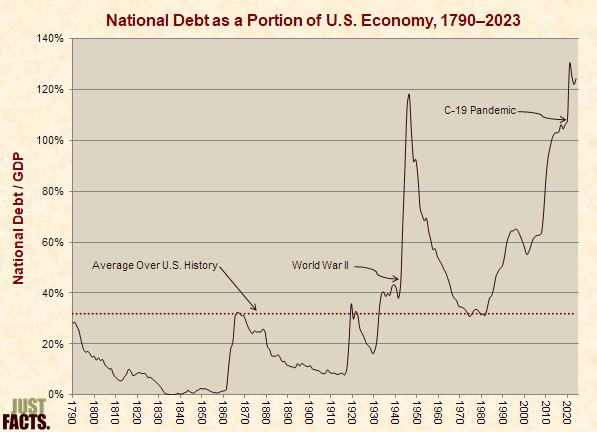
(https://www.justfacts.com/nationaldebt.asp)
How big is a trillion?
We hear words like billion or trillion thrown around on the news like they are talking about a billion as pocket change and a trillion as the cost of a house. These numbers are not bigger than most people can truly comprehend.How big is a trillion? For starters, just look at it:
$1,000,000,000,000
That's a lot of zeros! If you're middle class in this country, you might make $100,000, while a college student with a decent job might make $10,000 Let's look at those together:
$1,000,000,000,000
$100,000
$10,000
Here's another way of looking at it: 1 million seconds is about 11.5 days, 1 billion seconds is about 32 years, and a trillion seconds is equal to 32,000 years.
How bad is the problem?
$23 trillion in debt is nearly $70,000 per citizen in the U.S. and over $187,000 per taxpayer. With the annual deficit alone exceeding $1 trillion, the difference between income and spending will add over $3,000 per adult to the debt total in 2020.(http://www.usdebtclock.org/)
At the end of FY 2018 the debt was $21.46 trillion, or 107.1% GDP.
The highest federal debt in US history was 119.0% GDP in 1946 just after World War II.
At the end of FY 2018 the federal deficit was $779 billion, or 3.9% GDP
The highest federal deficit in US history was 29.0% GDP in 1943 during World War II.
(https://www.usgovernmentdebt.us/debt_deficit_history)
(https://www.justfacts.com/nationaldebt.asp)
How did we get here?
Let's go back to 1790, when the new country had a debt of just over $75 million, which was a debt-to-GDP ratio of about 30%. As the debt accumulated during the American Revolution was paid down, the ratio improved greatly until a spike during the War of 1812. That was paid down to almost nothing by the 1830s and staying low for nearly a generation.
With the onset of the Civil War, the debt naturally rose again in order to cover the immense cost of war, from about $65 million in 1860 to $2.76 billion in 1866. The first income tax was levied to help pay down that debt. It took longer, but by 1916, the debt-to-GDP ratio was under 3%.
When the U.S. got involved in World War I, the debt rose again, reaching 33% of GDP at more than $25 billion. By 1930, the debt was reduced by more than $9 billion.
During the Great Depression, the debt rose for the first time not due to war, but due to peacetime economic conditions. President Roosevelt's New Deal programs caused the debt to rise to over $40 billion, while the economic collapse dried up revenues, so the debt-to-GDP ratio jumped to 44% by 1934.
With the onset of World War II, the debt climbed further, to nearly $242 billion by 1946 (equivalent of nearly $3 trillion in today's dollars), which was a staggering 113% of GDP. The debt got to it's lowest post-war level in 1974 (after Korea and Vietnam), at over $343 billion, which was 24% of GDP.
During the Great Depression, the debt rose for the first time not due to war, but due to peacetime economic conditions. President Roosevelt's New Deal programs caused the debt to rise to over $40 billion, while the economic collapse dried up revenues, so the debt-to-GDP ratio jumped to 44% by 1934.
With the onset of World War II, the debt climbed further, to nearly $242 billion by 1946 (equivalent of nearly $3 trillion in today's dollars), which was a staggering 113% of GDP. The debt got to it's lowest post-war level in 1974 (after Korea and Vietnam), at over $343 billion, which was 24% of GDP.
When Ronald Reagan took office in 1980, the country was facing high inflation, which led to high interest rates, plus high unemployment, and a general national malaise. Tax reform triggered a period of economic growth, but the lower revenues, combined with high defense spending as the U.S. sought to approach the cold war as an economic battle, plus increased spending for social programs led to the debt climbing to $3.6 trillion in 1995.
In the 1992 Ross Perot ran a failed but surprisingly strong presidential campaign based largely on his concern for the future of the country with over $1 trillion in national debt. Bill Clinton won that election, in part due to President Bush losing support among some conservatives for breaking his "read my lips, no new taxes" pledge, which was due to a compromise he made to try and improve the budget situation.
During Clinton's first term, Republicans took control of the House of Representatives in 1994 with promises of cutting spending to sustainable levels. Clinton initially fought the reforms but eventually embraced them as politically expedient. The combination of the 1990 tax increases under Bush, the additional tax increases under Clinton, and the Gingrich-led spending cuts, the debt seemed under control. By 2001, the national debt was down to 33% of GDP, and the budget projected a small surplus, which led to optimism that the debt could be reduced significantly or perhaps even eliminated over the next decade.
During Clinton's first term, Republicans took control of the House of Representatives in 1994 with promises of cutting spending to sustainable levels. Clinton initially fought the reforms but eventually embraced them as politically expedient. The combination of the 1990 tax increases under Bush, the additional tax increases under Clinton, and the Gingrich-led spending cuts, the debt seemed under control. By 2001, the national debt was down to 33% of GDP, and the budget projected a small surplus, which led to optimism that the debt could be reduced significantly or perhaps even eliminated over the next decade.
When George W. Bush came into office in 2000, riding a wave of optimism, he pushed through tax cuts in order to return the surplus to the taxpayers. The hope was that the economic growth would lead to the debt-to-GDP ratio improving without accelerating the repayment of the debt, even while expanding some government programs. However, U.S. response the terrorist attacks on 9/11/01 led to high deficit spending again as always happens in times of war, and the debt began to climb once again, although slowly, as the Republican-led Congress attempted to hold non-military spending in check.
By 2008, late in Bush's second term, a major recession hit, which required drastic measures to stabilize the banking system, and the debt-to-GDP ratio jumped to over 40%. With GDP falling due to recession and spending continuing to increase, momentum began building toward ever-growing debt. The first major action in Barack Obama's first term as president was an enormous economic stimulus package that led to a debt level surpassing $10 trillion at the beginning of 2012, while continuing to grow rapidly.
(https://www.theatlantic.com/business/archive/2012/11/the-long-story-of-us-debt-from-1790-to-2011-in-1-little-chart/265185/)
(https://www.thebalance.com/national-debt-by-year-compared-to-gdp-and-major-events-3306287)
The estimated tax revenue for the U.S. government is $3.485 trillion. Fortunately the interest rate is low, so the interest paid is approaching $373 billion as we approach the end of 2019, so the DTI for the US government is only 11%. However, interest rates will eventually go up, and when they do, the deficits will rise quickly as well, as the interest payments will increase.
Fortunately, most of the U.S. debt is held domestically, but the top foreign holder of American debt is China. As of October 2018, China held $1.138 trillion of our debt. While the Chinese couldn't liquidate their investment quickly without wrecking their own economy, it still puts us in a place of weakness with the top challenger for Americas place as the top superpower on earth.
The social security trust fund and federal pension funds hold 28% ($5.7 trillion) of the U.S. debt. That may sound good. because it's the government owing itself. However, the fact is that the trust fund can't just liquidate those low interest bonds to make social security payments to the growing elderly population. On top of that, the funds have and are missing the high returns over time of private pension fund and 401k investments and so unable to grow much beyond the payroll taxes coming in. That simply exacerbates the problem.
(https://www.thebalance.com/who-owns-the-u-s-national-debt-3306124)
(https://www.thebalance.com/national-debt-by-year-compared-to-gdp-and-major-events-3306287)
With the surprising election of populist Donald Trump as President in 2016, a friendly Republican-led Congress pushed through tax cuts to accelerate the recovery that had been progressing at a relatively anemic rate compared to prior recoveries. The result was reduced revenues that were not offset but a large enough economic boost, and with a new breed of Republicans in power that no longer seem concerned with controlling spending, the debt is rising to astronomical levels.
Listening to the proposals of the many candidates for the Democratic party nomination for president going into the 2020 elections, it seems that Trumps opponents are simply trying to outdo each other with costly proposals. Entitlement spending (Medicare, Medicaid, Welfare, Social Security) already consume nearly 60% of the budget.
If we continue to increase spending (and therefore borrowing), we will eventually reach a tipping point. When the next recession hits, the GDP will fall, and the debt-to-GDP ratio will rise without any actual increase in debt. Creditors will insist on higher interest payments due to the increased risk of default.
If we continue to increase spending (and therefore borrowing), we will eventually reach a tipping point. When the next recession hits, the GDP will fall, and the debt-to-GDP ratio will rise without any actual increase in debt. Creditors will insist on higher interest payments due to the increased risk of default.
Wait, I still don't understand
If we compare the federal debt to personal debt, we can look at the debt-to-income ratio (DTI) used by lenders to determine how much debt a person can carry without defaulting. The general guideline is a maximum of 43% DTI to get a mortgage, although most lenders look for a ratio below 36% with the mortgage itself less than 28%.The estimated tax revenue for the U.S. government is $3.485 trillion. Fortunately the interest rate is low, so the interest paid is approaching $373 billion as we approach the end of 2019, so the DTI for the US government is only 11%. However, interest rates will eventually go up, and when they do, the deficits will rise quickly as well, as the interest payments will increase.
Why should I be concerned?
Popular author and radio show host Dave Ramsey has helped millions of people get out of debt and find financial peace. As a Christian, he developed his approach to managing finances from the Bible. One verse he is fond of quoting is Proverbs 22:7, "The rich rule over the poor, and the borrower is a slave to the lender."
Fortunately, most of the U.S. debt is held domestically, but the top foreign holder of American debt is China. As of October 2018, China held $1.138 trillion of our debt. While the Chinese couldn't liquidate their investment quickly without wrecking their own economy, it still puts us in a place of weakness with the top challenger for Americas place as the top superpower on earth.
The social security trust fund and federal pension funds hold 28% ($5.7 trillion) of the U.S. debt. That may sound good. because it's the government owing itself. However, the fact is that the trust fund can't just liquidate those low interest bonds to make social security payments to the growing elderly population. On top of that, the funds have and are missing the high returns over time of private pension fund and 401k investments and so unable to grow much beyond the payroll taxes coming in. That simply exacerbates the problem.
(https://www.thebalance.com/who-owns-the-u-s-national-debt-3306124)
What can we do about it?
A Balanced Budget Amendment would be ineffective. In fact, it would tie the hands of the government to borrow when it is needed, or even to set money aside to use in future years.
(https://www.cbpp.org/research/federal-budget/constitutional-balanced-budget-amendment-poses-serious-risks)
Still, the government needs to have a budget that is balanced whenever possible. The government instead has resorted to continuing resolutions that provide funding without a budget, games with 10 year projections that never pan out due to shifting political winds, etc.
(https://www.thebalance.com/the-u-s-debt-and-how-it-got-so-big-3305778)
Bankruptcy is not an option. While an individual or a corporation can file for bankruptcy protection in order to hold creditors at bay while working to address crushing debt, a nation such as the United States cannot resort to such an action. The impact on the national and global economies would be devastating.
Taxes alone are not the solution. The Bush tax cuts were unnecessary but well-intentioned, and they should not have been extended in 2003 once spending had increased due to the increase in military spending after 9/11. The Trump tax cuts were also unnecessary since there was already a recovery underway, albeit weak. No matter how much you increase taxes on the small percentage of the population that pays most of the taxes, there will not be enough revenue. Tax increases need to be paired with spending cuts. That's how it was done in the 1990s as well as the post-war periods throughout the nation's history.
Still, the government needs to have a budget that is balanced whenever possible. The government instead has resorted to continuing resolutions that provide funding without a budget, games with 10 year projections that never pan out due to shifting political winds, etc.
(https://www.thebalance.com/the-u-s-debt-and-how-it-got-so-big-3305778)
Bankruptcy is not an option. While an individual or a corporation can file for bankruptcy protection in order to hold creditors at bay while working to address crushing debt, a nation such as the United States cannot resort to such an action. The impact on the national and global economies would be devastating.
Taxes alone are not the solution. The Bush tax cuts were unnecessary but well-intentioned, and they should not have been extended in 2003 once spending had increased due to the increase in military spending after 9/11. The Trump tax cuts were also unnecessary since there was already a recovery underway, albeit weak. No matter how much you increase taxes on the small percentage of the population that pays most of the taxes, there will not be enough revenue. Tax increases need to be paired with spending cuts. That's how it was done in the 1990s as well as the post-war periods throughout the nation's history.
One way to reduce the impact of the debt is for inflation to devalue the dollar to the point where the debt has less value. However with this level of debt, that would require hyperinflation similar to what Germany experienced after World War I due to the cost of reparations. More recently Venezuela has been devastated by hyperinflation caused by a loss of oil revenue to fund the high spending necessary in a socialist system.
Another solution would be severe austerity measures, cutting spending to the bone, ending social programs entirely, and so forth. If the situation gets bad enough, moderate tax increases combined with reasonable spending decreases won't be enough. When the European Union insisted on austerity measures for Greece in order to agree to more loans, the impact on the citizens was tremendous.
Unfortunately, if we don't address this soon, austerity may be the best option. As Dave Ramsey would say, when you are working to get out of debt, you need to get whatever extra income you can, drive an old car you can buy with a little cash, and survive on beans and rice. Let's stop the insanity, get spending and revenues in line in a way that won't wreck the economy, and we can still leave a better future for our children and grand children.
Another solution would be severe austerity measures, cutting spending to the bone, ending social programs entirely, and so forth. If the situation gets bad enough, moderate tax increases combined with reasonable spending decreases won't be enough. When the European Union insisted on austerity measures for Greece in order to agree to more loans, the impact on the citizens was tremendous.
Unfortunately, if we don't address this soon, austerity may be the best option. As Dave Ramsey would say, when you are working to get out of debt, you need to get whatever extra income you can, drive an old car you can buy with a little cash, and survive on beans and rice. Let's stop the insanity, get spending and revenues in line in a way that won't wreck the economy, and we can still leave a better future for our children and grand children.
Comments
Post a Comment